See it. Hear it. Connect it.
Diagrams, visual models, spoken explanations and meaningful examples offer different routes into the same curriculum objective.
FOR PARENTS. BUILT AROUND YOUR CHILD.
See what’s clicking, understand what’s difficult, and know how to help. Thoughtful learning support for your child. A clearer picture for you.
Different pieces. The same whole.
Explore the reasoning behind it.
FIND THE RIGHT STARTING POINT
A CURRICULUM. MANY WAYS TO UNDERSTAND IT.
More pictures when an idea needs to be seen. Audio alongside a clear transcript. Worked reasoning, purposeful questions and a mix that can change as understanding grows.
Diagrams, visual models, spoken explanations and meaningful examples offer different routes into the same curriculum objective.
Choose smaller steps or explore a full worked example. Adjust pace and challenge without reducing ambition or talking down to the learner.
Short checks, explanation questions, later recall and unfamiliar applications can reveal understanding beyond simply completing a task.
Personalisation is a changing teaching mix, not a label. The intended platform will use curriculum context, learner choices, evidence of understanding and teacher guidance to refine the next step. Choosing pictures does not make a child a fixed “visual learner”.
Build a preview learning mix ↗This public sandpit shows a few scripted learning moments and fictional journeys. It is intentionally far simpler than the platform we are developing. The complete vision includes richer curriculum coverage, ongoing learner modelling, varied resources and evidence-led adaptation. Those capabilities are not active here, and their quality will need to be validated before launch.
Explore freely. No account, no real child data, no saved progress.
LEARNING THAT SEES THE WHOLE CHILD
Some children need a different explanation. Others need a new challenge. Our vision is support that notices the difference — and makes the next step feel possible.
A gentle check-in explores what they know, without turning a year group into a label.
Thoughtful hints, visual examples and smaller steps help a tricky idea finally click.
Fresh challenges and later revisits check understanding beyond a single right answer.
These are the principles guiding Study Buddy’s development. Explore the working example below.
DIFFERENT METHODS. ONE LEARNING GOAL.
A diagram can make an idea visible. A worked example can make the reasoning clear. Choose an approach that helps with this topic — without putting a learner into a fixed “learning style”.
Compare two bars: three of four parts and six of eight parts cover the same amount. The picture connects the symbol to its meaning.
Make an abstract relationship visible, then connect it back to the mathematical reasoning.
Explore these approaches in the basic fractions preview. The sandbox lets you combine pictures, audio, worked steps and checks. Browser read-aloud requires an available voice. Full curriculum coverage and ongoing adaptation are still in development.
LESS TELLING. MORE SHOWING.
Choose an example that sparks their curiosity.
Then try a tiny learning moment for yourself.
Take your time. It’s okay to try.
A scripted example, using no child data or live AI. This demo does not assess mastery.
FOR THE PEOPLE CHEERING THEM ON
You want to know what’s clicking, what’s tricky, and how to help. Study Buddy’s parent experience is being designed to turn learning evidence into clear, practical next steps.
Two fresh questions answered without hints.
Check what sticks with a different example.
“If we cut the same pizza into 4 or 8 pieces, how many pieces make half?”
A conversation, not another test.Synthetic example. No real learner records.
A LOOK INSIDE THE SUPPLIED APPLICATION
Actual screenshots from the supplied working demo show the pupil, parent and teacher journeys. Names, schools and results are synthetic. These captures show the interface before the latest brand refresh.
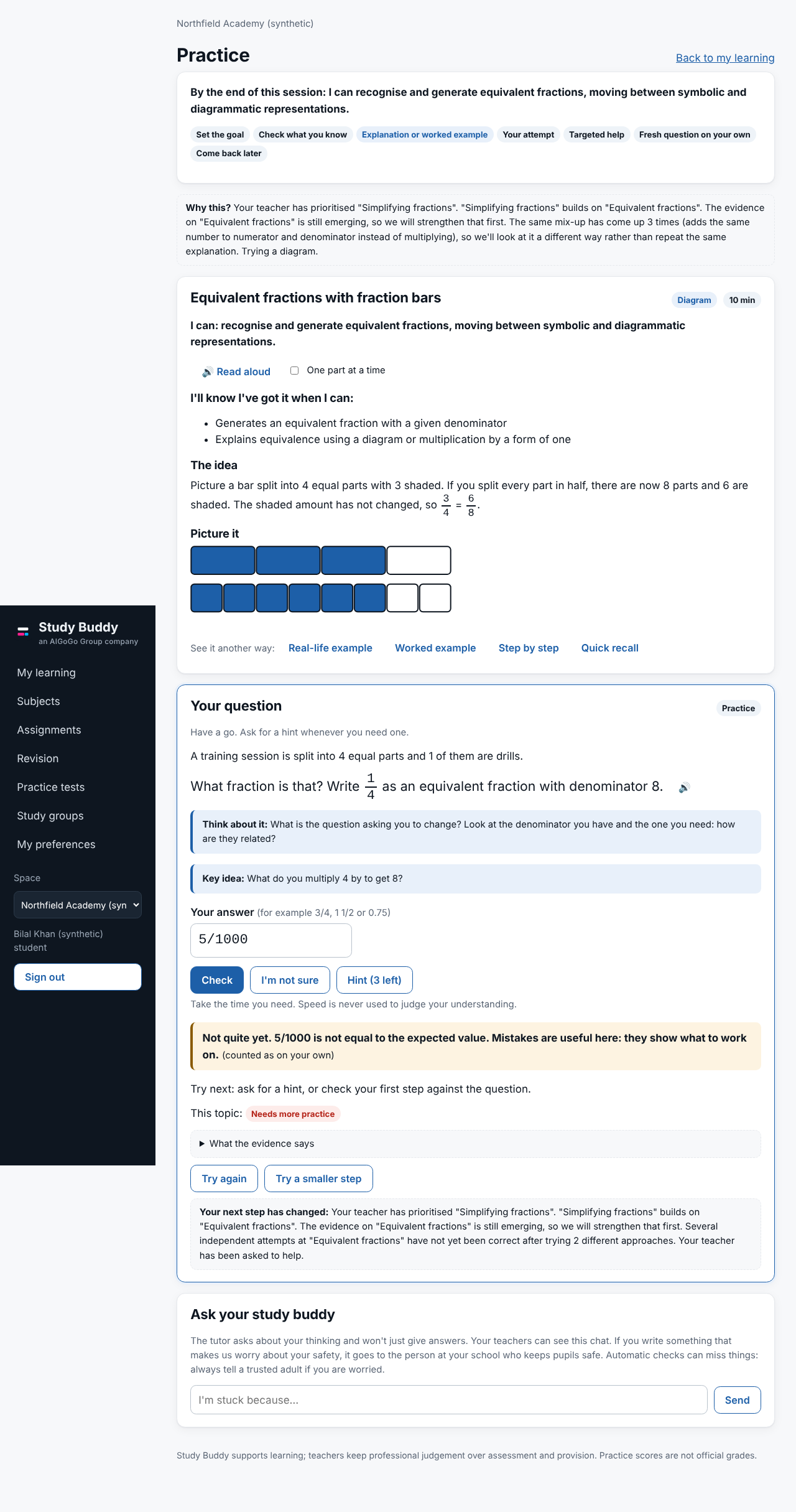
Diagrams, worked examples, read-aloud and hints sit alongside a fresh attempt.
View the full screenshot ↗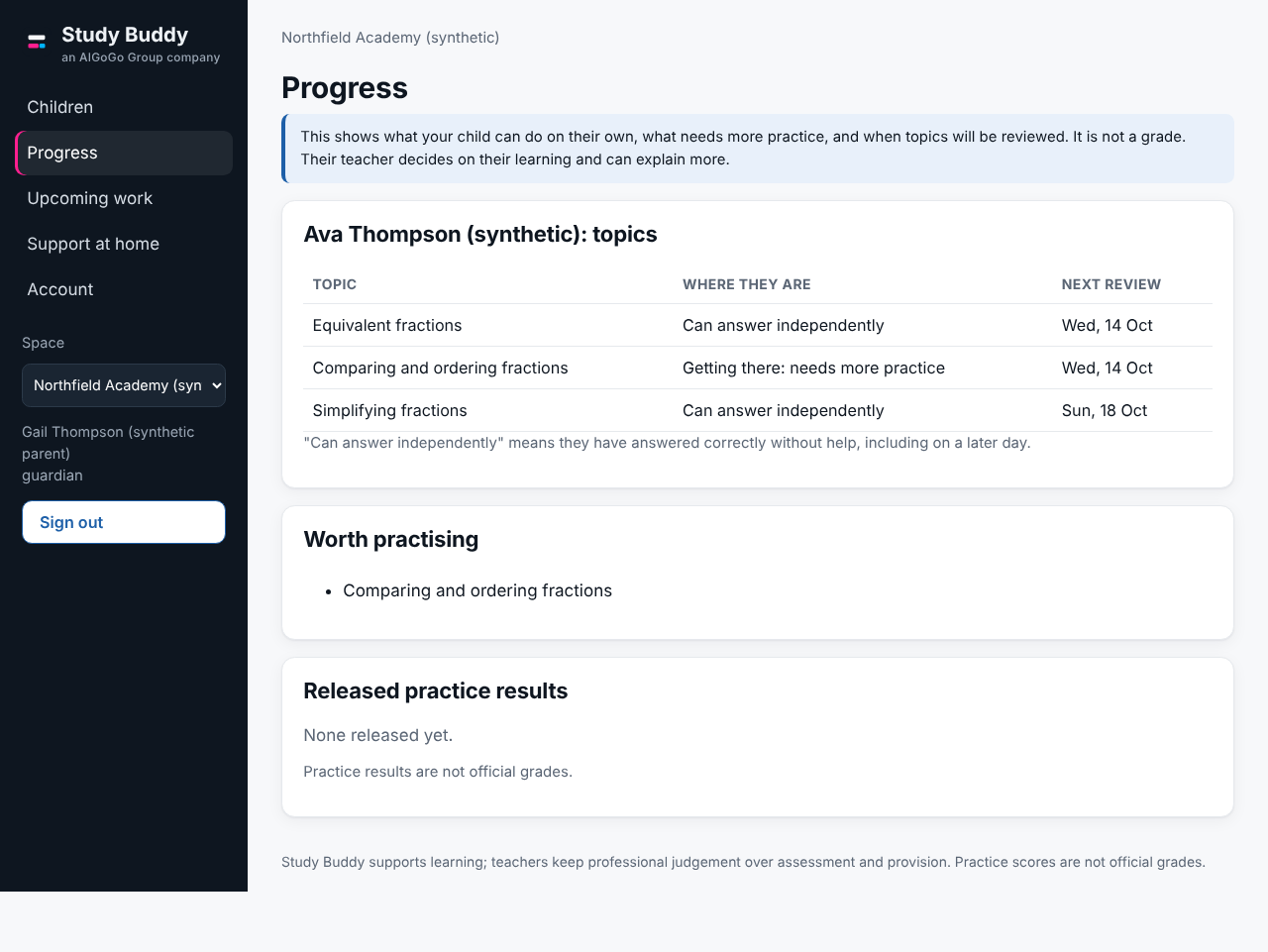
A plain-language view of independent answers, review dates and released results.
View the full screenshot ↗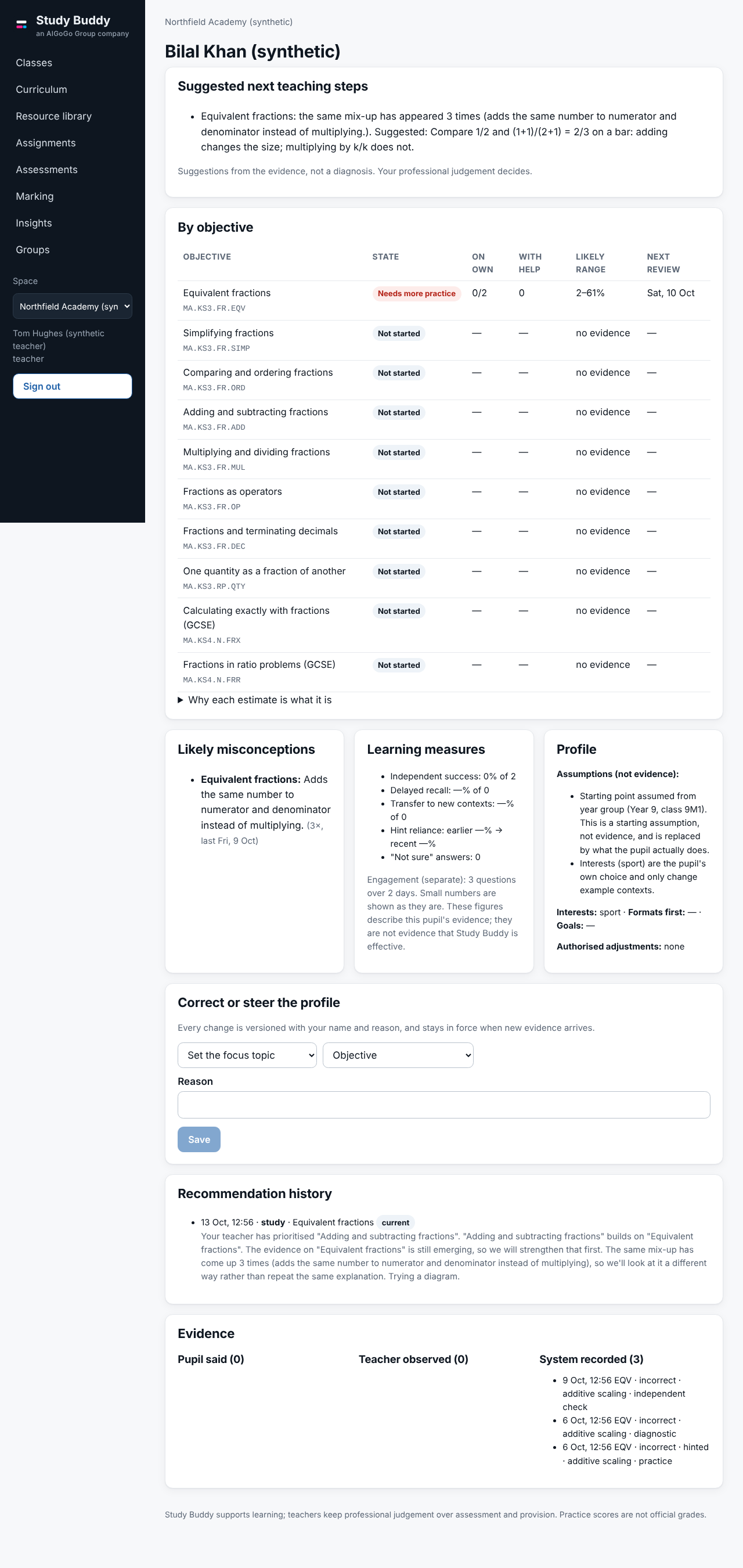
Inspect misconceptions and uncertainty, and correct or steer the learning profile.
View the full screenshot ↗PROMISING RESEARCH. HONEST EXPECTATIONS.
Research across adaptive software and online human tutoring gives us reasons to be optimistic — and a responsibility to measure what actually helps.
In a randomised study of 619 students in Delhi, students offered a Mindspark programme scored 0.37 standard deviations higher in maths after about 4½ months.
Read the J-PAL evaluation ↗A randomised online tutoring programme found a 0.20 standard deviation improvement in 2022 with three hours of individual tutoring each week; the 2020 effect was 0.23.
Read Carlana & La Ferrara ↗A review of 107 effect sizes found intelligent tutoring associated with higher achievement than large-group teaching (g = 0.42). It found no significant difference versus individual human tutoring.
Read Ma et al., 2014 ↗SD and g describe differences relative to variation in scores; they are not percentage improvements. These studies evaluated other programmes, with different learners and settings. They do not establish Study Buddy’s effectiveness or guarantee your child’s results.
THE PRINCIPLES BEHIND THE METHODS
Short extracts from published guidance and research. These sources inform the approach; they are not testimonials or endorsements of Study Buddy.
“Teachers can promote metacognition by modelling their thinking aloud.”
Worked reasoning and reflection help learners understand how to approach a task.
“However, not all feedback has positive effects.”
The purpose is a specific next action, not simply more corrections or praise.
“on the delayed tests, prior testing produced substantially greater retention than studying”
In two prose-learning experiments, retrieving information helped later recall. This does not guarantee the same effect in every context.
TRUST IS SOMETHING YOU BUILD
Designed to support the teachers, parents and human relationships children already rely on.
Explain the next step, make uncertainty visible, and let adults question a recommendation.
No public rankings in this experience. Learning and confidence matter more than chasing streaks.
Our design commitments. Live-service privacy, safeguarding and accessibility details must be confirmed before launch.
GOOD QUESTIONS
You can try the illustrative learning demo on this page now. The supplied application includes pupil, parent and teacher journeys with synthetic demo data. Hosting and live-service preparation are ongoing; the open sandbox lets you explore synthetic pupil, parent and teacher views without signing in. It does not save learning records or provide live tutoring.
The intended experience focuses on teaching, graduated hints and checking understanding. The demo here is scripted. Live AI capabilities and their oversight will need to be verified before release.
The project is being developed around curriculum-aligned learning. This page demonstrates fractions. Confirmed age ranges, subjects and curriculum coverage will be published when available.
This landing page asks for no child information. Demo answers are processed in your browser without a backend. Before live use, Study Buddy needs a published privacy notice, access controls and verified safeguarding processes.
Pricing and launch dates have not been confirmed. There is no payment or subscription flow on this page.
EVERY “I GET IT” STARTS SOMEWHERE.
A brighter learning experience starts with understanding the child.
Explore the open demo ↗Try the demo. No sign-up. No child data.